


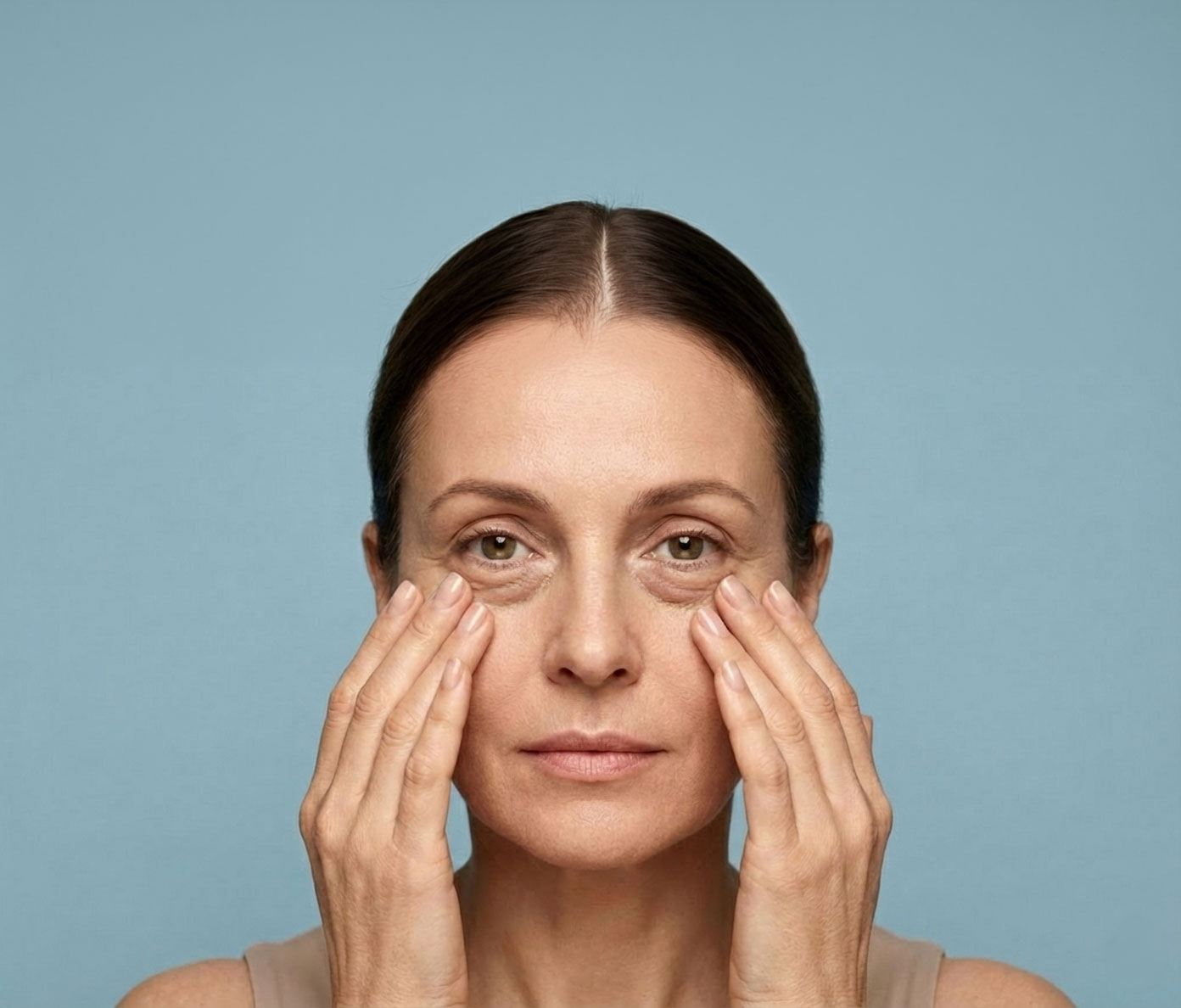
The eye area is one of the regions where aging shows itself earliest and most noticeably. One key reason is that the skin of the lower eyelid is very thin and the area moves constantly throughout the day with facial expressions.
But the eye area is not only a “marker of youth”; it is also a frame that carries emotion and expression. That’s why sagging, puffiness, or hollowness of the lower lid can make a person look not only “older,” but also more tired, more tense, or even sadder. Many patients come in with the feeling: “I don’t feel this way, but this is how I look.”
Why Does It Happen – and What Does It Mean?
Changes in the lower eyelid usually arise from a combination of mechanisms. A genetic predisposition may set the stage; but with age, tissue laxity, loss of skin elasticity, and shifts in fat pads make the picture more pronounced.
In some people, the lower-lid fat pads herniate forward and create a “baggy” appearance.
In others, the supporting tissues of the midface/cheek weaken; the lid-cheek junction sharpens and a hollow – what we call a “tear trough” – becomes more visible as a shadow in the mirror.
A heavy workload, stress, poor sleep, alcohol, and smoking can also negatively affect circulation and tissue quality, worsening these concerns. The realistic takeaway is this: once noticeable sagging or prominent bags develop in the lower lid, it is usually not accurate to expect a complete spontaneous reversal.
Non-Surgical Options
The aim of non-surgical treatments is to achieve a more rested, more balanced eye area by targeting the right problem in the right patient. My basic approach is this: if the issue is mild to moderate and the main problem is hollowness/shadowing and reduced tissue quality, it may be possible to soften the transition with non-surgical methods.
However, these treatments generally improve appearance rather than eliminate the structural cause. That is why patient selection and expectation management are critical.
“Light” Fillers / Collagen-Supporting Fillers
In mild to moderate tear-trough hollowing, collagen-stimulating/supportive fillers applied with the right technique (often referred to as “light fillers” for this region) can soften the under-eye-cheek transition. The goal is to reduce the shadow and create a more rested expression.
Best candidates: younger to mid-age patients with good skin quality and without pronounced fat herniation.
Limitation: in older patients where bags are prominent, skin laxity is increased, and cheek tissue has shifted downward, fillers can be insufficient. In some individuals, unwanted effects such as prolonged swelling/edema may also occur. In this group, I generally consider surgery more strongly.
Treatments That Support Tissue Quality
Fractional radiofrequency microneedling methods such as Morpheus8 aim to support skin tightness, tissue firmness, and overall skin quality in suitable patients. If fine wrinkles and loss of elasticity are the main concerns, this can be a valuable option.
However, in the presence of advanced bagging and significant excess skin, it should not be thought of as a standalone procedure that “eliminates the bag.”
Volume + Quality Support: Stem-Cell-Enriched Fat, Exosomes
In some patients, stem-cell-enriched fat injections can help both to restore volume loss and to support tissue quality.
Exosome applications can also be among the options aimed at tissue renewal; however, because product content, protocols, and the level of scientific evidence can vary by center and by country, they should be approached with physician evaluation and realistic expectations.
In short: non-surgical procedures can help the right patient “look better,” but their effects are often limited and may require follow-up and repeat sessions. For that reason, I prefer to first clarify the main source of the problem (is it hollowness, bagging, excess skin, cheek support?) and then build the plan step by step.
Surgery: Lower Blepharoplasty
The main goal of lower eyelid surgery is to correct – in a more lasting, more balanced way – the structural changes that make the eye area look older and tired. The aim is not only to “remove excess,” but to create a more harmonious anatomy at the lid-cheek transition.
Planning is made based on details such as excess skin, muscle support, the status of fat pads, laxity of the lateral canthal tendon, and the position of the cheek tissues.
Not Every “Bag” Is the Same
In some patients, fat tissue has clearly herniated forward; in such cases it may be reduced in a controlled way, or repositioned to create a more natural transition.
In others, fat has atrophied or is unevenly distributed, creating indentations or hollows under the eye. In those situations, the goal is less about removing fat and more about rebuilding volume in the right place.
The Eye Is a Whole
If there is age-related laxity and downward shift at the outer corner of the eye, supportive procedures such as canthopexy/canthoplasty may need to be added.
Also, focusing only on the lower lid is not always enough. If there is significant upper-lid hooding, it can be harder to achieve the desired rejuvenation effect with lower-lid surgery alone; in some patients, planning upper and lower lids together is more appropriate. Sometimes, a more holistic approach (such as midface/cheek support) creates a better-balanced result.
The Process: Before and After
When planned and performed with the right technique, lower eyelid surgery aims to “rest” the face without changing expression.
Before surgery
As with any surgery, medications and supplements that can increase bleeding are reviewed. Aspirin-like blood thinners and certain herbal products are stopped for the period recommended by your physician. If there are additional conditions such as glaucoma or dry eye, the process is planned – when needed – with evaluation by the relevant specialist.
Surgery and duration
The procedure often takes around 60-90 minutes. The type of anesthesia is chosen according to the patient’s needs and the planned steps.
After surgery
In the first days, especially in people with sensitive skin, swelling and bruising may occur; this is usually temporary. Key points that support healing include:
- Cold compresses in the first days
- Resting with the head elevated
- Protecting the incision line from trauma during the first week
- Keeping the area away from water until the time approved by your physician
- Avoiding activities that require bending the head forward
At follow-ups, timing for suture removal and the transition to skincare are planned. Because incisions are usually placed along the lash line and natural folds, scars are not prominent in daily life; the mild pinkness of the early period gradually fades.
My Approach
In many patients where prominent bagging, excess skin, and tissue laxity coexist, I plan lower eyelid surgery as the primary and most effective solution. In appropriate indications, surgery addresses the source more directly and provides a more lasting improvement.
That said, in patients with mild to moderate issues, I also offer non-surgical options – stem-cell-enriched fat injections, exosome applications in suitable conditions, Morpheus8, and collagen/light fillers – with scientific realism and proper expectation setting. In some patients these methods are sufficient on their own; in others, they serve as a bridge until surgery, supporting the tissue and helping the patient look better in the meantime.