



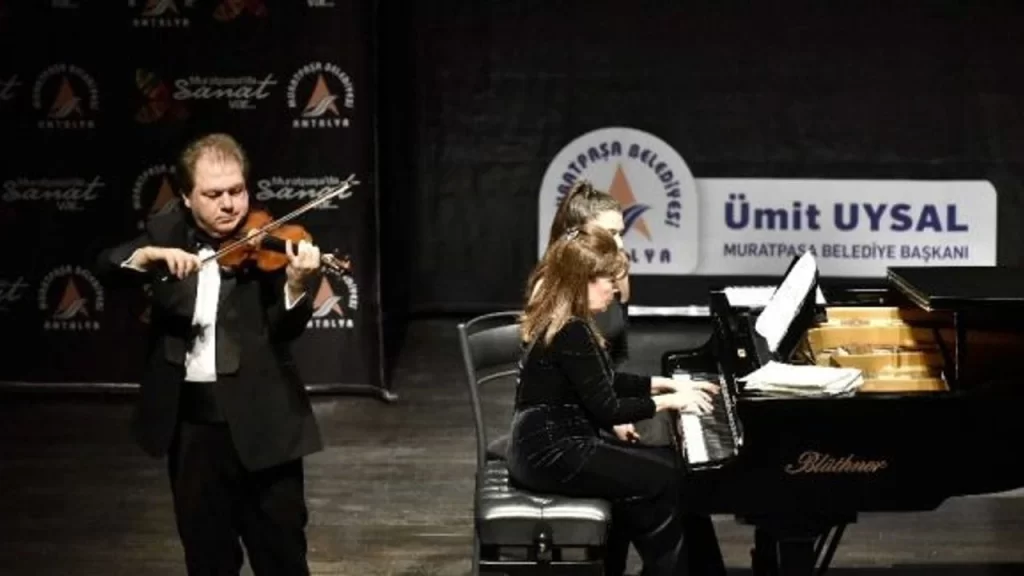
First of all, dear Ms. Mehru, I’m very happy to host such a valuable academic and musician in my column. I’d like to hear a bit about you, your student years, how you came to meet the piano professionally, and what you are doing now.
To briefly summarize my educational background: I started primary school at Kültür College, completed high school at Erenköy Girls’ High School, and then entered Istanbul University Faculty of Pharmacy. When I was in the third grade of primary school, I took the talent exam for the Istanbul Municipal Conservatory. My mother had secretly registered me for this exam without telling my father, because my father wanted his daughters to become either doctors or pharmacists.

Before learning the exam results, my mother told my father that I had taken the exam, but that it would be very difficult for me to pass, and asked him to go and find out the results. When my father went to the conservatory and learned that only 10 out of 600 people had passed the exam, I remember with joy how proud he was, saying, “My daughter was born for applause,” and how he supported me for the rest of his life. In short, at the age of 8, I began studying with distinguished pianists such as Prof. Ova Sünder, Verda Ün, and Prof. Meral Yapalı, eventually graduating from the conservatory’s advanced program. With a scholarship, I attended the Mozarteum University in Salzburg, where I had the chance to work with esteemed professors and further develop myself. I completed my master’s degree at Marmara University and earned my Doctorate in Art (Sanatta Yeterlik) at Istanbul Technical University’s Social Sciences Institute. From the moment I started playing the piano, I knew my life would continue with it. Perhaps it was fate that directed me toward pharmacy—maybe because my father had once wanted his daughter to become a doctor or a pharmacist (a wish he never mentioned again after I entered the conservatory).
-In addition to your professional music education, I know you also have a journey in pharmacy. I’d like to hear about that as well.
-While studying at the Faculty of Pharmacy, I took a semester off to prepare for my conservatory graduation. I practiced 5–6 hours a day, without weekends or holidays, and successfully passed my exam. From a young age, I always studied in a highly organized and disciplined way, continuing both schools at the same time. But to be honest, the amount of effort I put into piano was so great that it was inevitable this would be my real profession. Of course, the encouraging opinions of my esteemed teachers further strengthened my resolve. The more effort I put in, the more I loved it; the more I loved it, the more effort I put in.
-These days, many parents feel hesitant about letting their children pursue music education full-time in a single discipline, preferring the idea of “having another profession to fall back on, and continuing with music on the side.” What are your thoughts on this?
-As I mentioned earlier, I continued two schools at the same time. Yes, I was conditioned with the idea of “having another profession to fall back on.” But I also studied at the Faculty of Pharmacy willingly. Parents naturally want their children to have better opportunities in life, which is why they sometimes push them toward fields they don’t really want. I believe they should certainly explain the challenges and obstacles that may arise, but in the end, they should support their children in choosing the profession they truly want the most.
-You are both a professional musician and a mother. Your daughter, Ms. Gülru, is also an extremely successful pianist. How did you balance your identity as a mother with your identity as a musician while raising her? How did you discover her interest in music, and when turning that discovery into professional training, were you her first teacher or did you seek guidance from another musician?
-My daughter Gülru began piano lessons when she was about 4.5–5 years old. At the time, I did not have the idea that she would become a professional pianist. In our home, we listened exclusively to classical music, and my husband, Şadi Ensari, is an amateur classical guitarist. So it felt almost natural that our daughter should learn to play a musical instrument. I thought she would start with piano and then move on to guitar. Gülru took the entrance exam for the part-time piano department at the Istanbul State Conservatory, where she studied with highly esteemed teachers. During this time, she also enrolled at the German High School in Istanbul. After winning numerous first prizes in the Jugend musiziert competitions held among German high schools worldwide, she became even more devoted to the piano and to music. With a scholarship from the German High School, she completed her bachelor’s degree at the Hochschule für Musik und Tanz Köln and earned her master’s degree in chamber music. She now performs professionally in many countries around the world.
-In addition to your identities as a mother, musician, and academic, considering that music requires a serious discipline in professional life, how did this affect your mother child bond with your daughter? In the stories of many famous musicians, we often see strong parental figures—mothers or fathers—who are also accomplished musicians. How were you able to manage this process? From here, what advice would you give to young mothers who are musicians themselves or who want to learn more about this subject?
—Of course, not every day in this process went smoothly. Continuing two schools at the same time—the Conservatory and the German High School—requires great dedication and discipline. There were moments when we clashed, and a few times I even suggested that she quit the piano, but she never accepted. Sometimes sacrificing sleep, sometimes giving up playtime, she truly worked hard to complete this journey.
It’s not only the child who must be disciplined; the family must be as well. Prof. Meral Yapalı was both my teacher and my daughter’s, and she played a major role in this journey. If the triangle of family, child, and teacher comes together in the right way, great progress can be made. That’s how it worked for us.
-In piano education for children, is there a must-have beginner method or practice that you swear by?
—There are many methods that can be used in piano education. An experienced teacher can draw from different methods depending on the child’s age, comprehension level, and abilities. The same method should not be applied to every child. The starting method for a preschool child may be different from that for a child who begins piano at the age of 10. The approach can also involve combining different methods depending on the student’s needs.
-Lastly, what advice, suggestions, or thoughts would you like to share with mothers regarding their children’s music, piano, or specialized training?
—Education that begins at an early age is considered a fundamental step in general education. Early-age piano education is a process that requires a high level of discipline and motivation. Regardless of their level of musical ability, music is a part of every child’s life, and every child enjoys including at least one musical activity in it. The benefits of music education to child development are undeniable. It has been definitively proven that children who begin this training at a young age show increased mathematical and verbal intelligence.
Among all instruments, the piano is the most suitable for practice and the one that can be started at the earliest age. Unlike other musical instruments, the desired sound is already ready on the piano. Piano education advances a child’s overall musical ability, improves their sense of hearing and rhythm, develops memory, enhances concentration, and contributes to mental growth. Playing the piano is not just about performing—it is also about practicing. Piano practice is a skill that develops through correct exercises and repetition. It is a long education that requires dedication, serious and patient work. The choice of the right method and techniques is important. The more competent the teacher, the more easily they can determine the right path to follow. In one-on-one lessons, the relationship between student and teacher is crucial. As a final note to parents, I would say this: proper piano education has a tremendous impact on a child’s mathematical and verbal intelligence. Every intelligent child, adolescent, or adult can learn to play the piano.
I extend my heartfelt thanks to dear musician and academic Mehru Ensari for being my guest this month. I hope our conversation has given our esteemed readers, as well as young mothers and mothers-to-be, insights into the relationship between children and music, and how music can be advanced through professional steps.
You can listen to Mehru Ensari’s musical album projects on online music platforms:
1998 – Minyatürler (Mehru Ensari – Cihat Aşkın)
2001 – Ege’nin Türküsü (Mehru Ensari – Cihat Aşkın)
2013 – Minyatürler 2 (Mehru Ensari – Cihat Aşkın)