



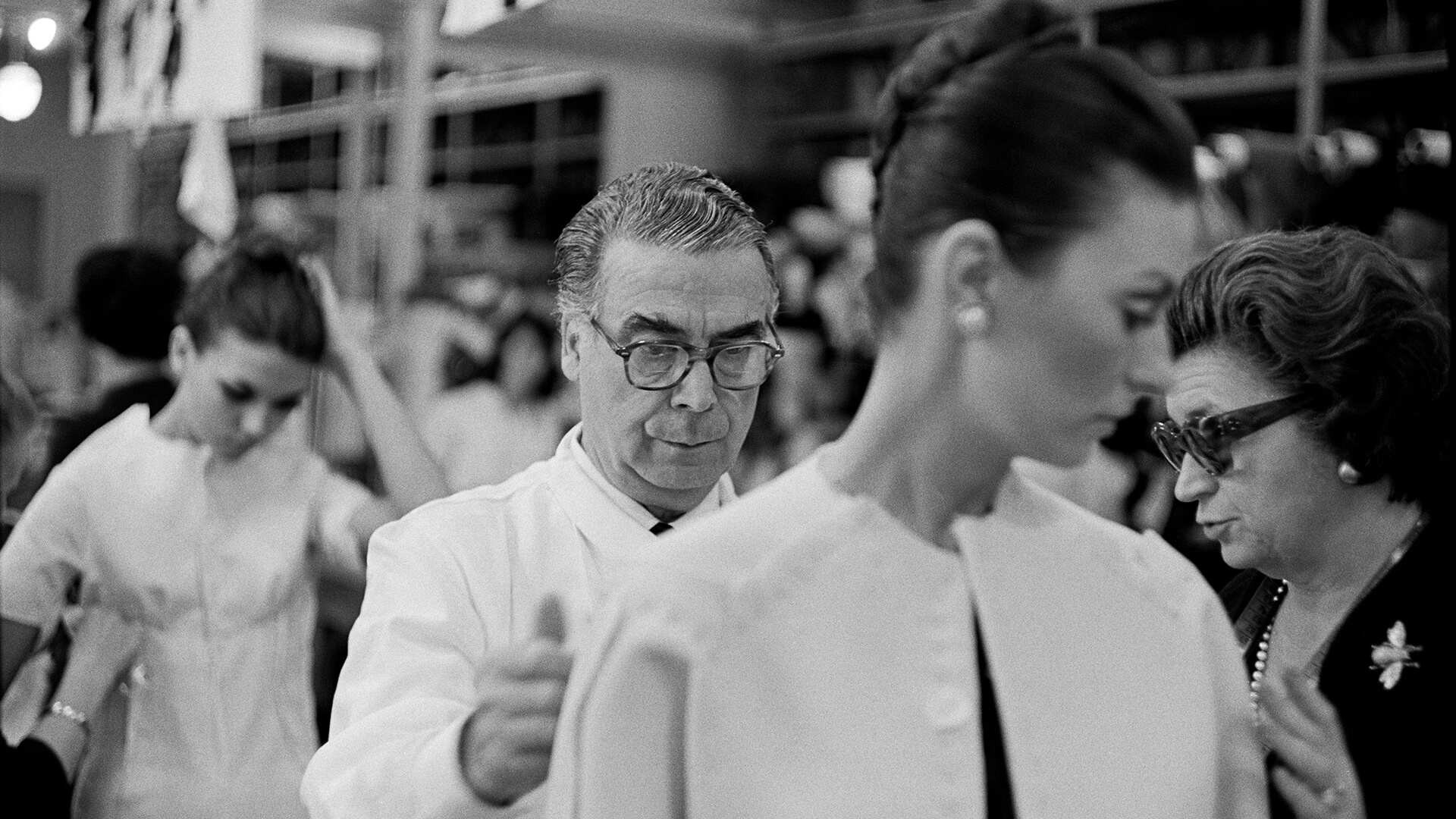
“A great designer must be an architect for form, a painter for color, a musician for harmony and a philosopher for measure.”
There’s a short, pithy Spanish word that Balenciaga often uses to describe the things he dislikes most in fashion. Cursi; It means vulgarity and bad taste. Of course, there is a reason why I started my article with such an introduction. For this reason, I recommend curious fashion readers to look at the history of the brand. When we look at the works the designer has done from the beginning to the end of his career and the silhouettes he has created, you will see how different and far away the brand is from its current image. Known for his excellent craftsmanship and innovative designs, Spanish couturier Cristobal Balenciaga was known as the ‘Master’ of haute couture. His work and vision that inspired those who followed in his footsteps were unique. An accurate analogy would be to say that haute couture is like an orchestra whose conductor is Balenciaga. Ironically, the collections created by the fashion house today are described as tasteless by many fashion critics! When you compare these two periods of the brand, you will see that there is only one thing in common, and that is that they adopted a design approach that was contrary and ahead of its time in both periods.
He was born in 1895 in Guetaria, Spain. Unfortunately, he lost his father, a local fisherman, at the age of 11. Therefore, from an early age, he began helping her mother, a seamstress in a noble house, learned the profession and fell in love with sewing and pattern-making. One of her mother’s clients, the Marquesa de Casa Torres, sent him to Madrid to receive formal fashion training. Immediately after his education, he opened her first boutique in San Sebastian, Spain, at the age of 24. Balenciaga went bankrupt in 1931 but later reopened stores in Madrid and Barcelona.
During this time, Spanish royalty and aristocracy wore his designs, but he was forced to close his stores due to the Spanish Civil War. At that time, the city of Barcelona was the favorite summer resort of Queen Maria Cristina and therefore attracted many aristocratic families who immediately noticed the sewing talent of the designer and artist Cristobal Balenciaga. This is how he entered the world of Haute Couture and began creating pieces for the richest families in the country.
At the outbreak of the Civil War, Balenciaga was exiled to Paris, where he opened his first couture house on Avenue George V in August 1937. He taught and inspired other designers, including Oscar de la Renta, Madeleine Vionnet, Christian Dior, Coco Chanel and Hubert de Givenchy. Andrè Courrèges and Emanuel Ungaro worked with him one-on-one. He continued to create great works of art and form friendships with the great masters of fashion. Many times there were personalities who declared him a genius. Coco Chanel, for example, did not hesitate to describe him as “the only one among us who is a real fashionista.” An indispensable genius in the history of fashion, but an unknown in his private life. He was always reluctant to give interviews and always stayed away from the press. In fact, he always made it clear: “Prestige is more important than fame. “Prestige is permanent, fame is temporary.”
Balenciaga closed his home in 1968 after working in Paris for thirty years. When customers asked him where they should go, he directed them to Givenchy. Jacques Bogart S.A. In 1986, he bought the rights to Balenciaga and opened a ready-to-wear line called Le Dix. After chief designer Michel Goma received mixed reviews, he was replaced by Josephus Thimister in 1992 and Balenciaga returned to elite status.
The brand is currently owned by Gucci Group. Nicolas Ghesquière, the creative director at the time, left the brand in 2012 and was replaced by Alexander Wang as creative director. In his first runway collection for Balenciaga in February 2013, Wang showcased clothing that honored Cristóbal Balenciaga’s fashion legacy; This was a mature and admirable move and earned the praise of his colleagues. Following Wang’s departure, Balenciaga announced Demna Gvasalia as its new creative director in October 2015.
A real ‘fashionista’ remembered all over the world
Although the company closed in 1968, its designs and recognition never disappeared from the fashion world. After several attempts to revive the brand in this way, finally Nicolas Ghesquière knew how to represent the essence of the master and return the company to the top of luxury brands.
Today, fortunately, we are lucky enough to see many of the designer’s original works at the Cristóbal Balenciaga Museum in his hometown of Guetaria. However, many of his works remain at the center of many other exhibitions around the world. A number of museums and galleries do not miss the opportunity to pay tribute to the great master of fashion whenever they can.