


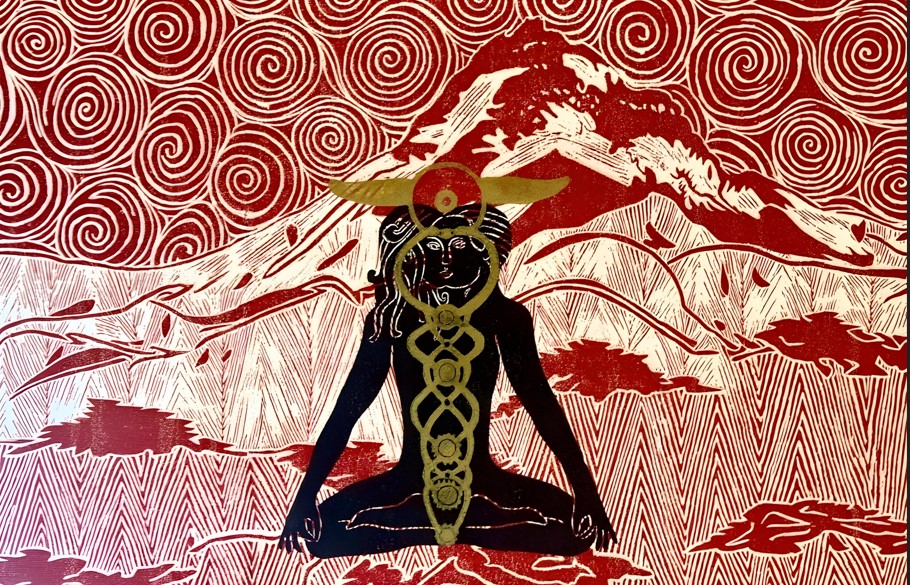
The sacred marriage ritual is a ritual that symbolizes the union of fertility gods and goddesses, especially encountered in Anatolian and Middle Eastern agricultural societies. This ritual represents the union of gods and goddesses, thought of as human-shaped, at least once a year in order to bring fertility to the earth and the fertility that will arise from this union. We still see symbolic reflections of sacred marriage, a ritual connected to ancient religious traditions, in the wedding traditions of the Turkish People.
The constant movement of nature and the fact that this movement contains certain patterns must have attracted the attention of human societies since the early ages when humans were still hunters and gatherers, and the famine that followed a dry season became man’s greatest fear from these early times when cultural life was just beginning to blossom. For this reason, people created their own rituals to ensure the regular functioning of the seasonal cycle, the abundance that would result from it, and the continuity of abundance.
Just as a pregnant woman’s belly grows, the soil swells in spring, and the plants that break through the soil are likened to the baby emerging from the growing belly when the time is right. The more the soil produces, the more the number of people increases, and when the soil does not produce, the number of people decreases. Thus, a similarity was found between the woman’s ability to give birth and the fertility of nature.
Humanity saw the soil as a woman and the woman as a goddess, and as a result, when these two abstract entities merged into one, the goddess who created everything by giving birth, mother earth, emerged. When this relationship between the woman and the soil was established, there was only one thing missing for fertility to be achieved; the emergence of a male god and the fertilization of this soil woman.
When this god and goddess united, the earth would turn green, the soil would become pregnant, the crops grown in the summer would be harvested in the autumn, and the abundant crops would be able to feed newborn babies and other family members in the winter until the following spring.
However, people had to do something to ensure this union. When they left the process to its own devices, sometimes things did not go well, and there was a famine because the god and goddess did not unite. The best way to intervene in this was to imitate them and honor them. For this reason, people thought that they could take the place of the god and goddess, imitate their union and birth as a game, and influence them through a kind of magic. All of these games and actions that people organize are called the “Sacred Marriage” or “Hieros Gamos” ritual.
The sacred marriage ritual is a ritual seen in all ancient civilizations that lived in the agricultural culture of Anatolia and its surroundings. The ritual begins with a ceremony that includes purification with water brought from a sacred water source. After the sacrifice or offering, the sacred union is revived like a theater play and ends with a ceremony where the fertility that this union will bring is celebrated, accompanied by a communal meal and music.
These games, which people repeated every spring and harvest season, gradually became part of traditions and every marriage within the society gained a sacred meaning. When ordinary weddings in daily life began to be performed as sacred marriage rituals, some parts of the ritual have changed significantly, but they have been passed down from generation to generation and are still alive today.
Turkish Wedding Traditions
For the Turkish people in Anatolia, a wedding is a sacred ceremony whose rules are determined and finalized by the society. However, although it is still unknown why it is performed, the continuation of rituals performed in the most distant times of history in these marriage ceremonies is an indication of the transfer of collective knowledge.
Anatolian Turks start their wedding ceremony with a process of cleansing by washing, which is a requirement of Islam, as ancient societies did before every religious ceremony. In Anatolia, great effort is made to make the bride cry on the henna night because of the idea that the bride’s tears will increase fertility.
Originally, the relationship between the bride’s tears and fertility is a reference to the tears shed for Dumuz, Tammuz, Adonis, Attis and Dionysus, the gods who symbolize the seasonal cycle by dying and resurrecting. According to the belief of ancient times, after the mourning and tears shed for the gods, the gods would be resurrected and married to the goddesses of fertility. Thus, the famine would end, the fertile spring would return again, and this would be celebrated with great enthusiasm. Therefore, the expectation of fertility, especially from the bride’s tears, bears traces of sacred
marriage ceremonies hidden in the depths of history.
In addition to making the bride cry, sprinkling wheat or rice over the bride and groom’s heads and sprinkling flour on door thresholds also take their place among Turkish marriage traditions. Of course, the wheat sprinkling ritual was one of the practices performed in ancient times to increase fertility. Again, in Ancient Greece, the bride would take her first step over the threshold of her groom’s house by biting a pomegranate. This action of the bride showed that she had entered her husband’s command and protection. In Rome, the bride would rub the doorknob with oil and tie woolen threads when entering the house. Again in Rome, since it was considered unlucky for the bride to step on the threshold, she would pass on the groom’s lap. This
tradition, which still continues today, was added to Turkish marriage rituals much later.
As can be understood from these examples, the Anatolian Turkish people considered the union of the bride and groom sacred, made efforts to increase their reproductive power and fertility, saw some objects as fertility enhancers and scattered these blessed objects in their homes, vineyards, gardens and fields.
In many parts of Anatolia, some parts of the Hieros Gamos ritual continue to be practiced, although they vary from region to region. Regardless of the traditions, we still see that every marriage ceremony from the westernmost to the easternmost is seen as a sacred ceremony and is directly associated with the fertility of nature.