



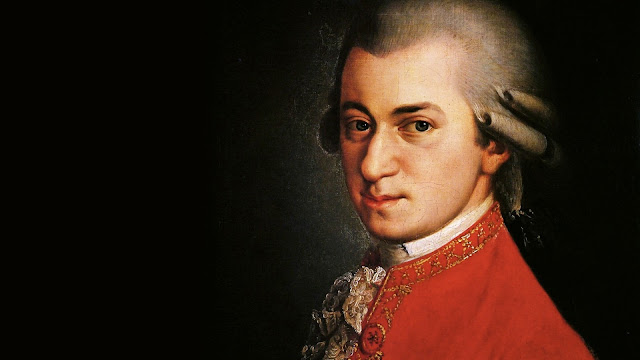
Wolfgang Amadeus Mozart made history not only with his productivity and creativity, but also with his extraordinary life story and musical genius. Born on January 27, 1756 in Salzburg, Austria, Mozart fascinated not only his own era but also future generations with his works created during his short but impressive life. In this column, I tried to tell you the story of Mozart’s life and his music, which is full of unforgettable effects, by addressing historical and musical details. Now, I ask you to make yourself a nice coffee or tea and open the playlist I prepared for you in the background and read the traces left by this genius musician. When you press search in your Spotify app, you can access the list by scanning the code with the camera sign in the upper right corner of the screen. Enjoy the music Shining as a bright star in the universe of music,

Wolfgang Amadeus Mozart is one of the greatest musical geniuses in history, with both his outstanding talent in composing and his impressive life story. Born in Austria in the second half of the 18th century and fascinating the world with the works he created during his short but impressive life, Mozart left a pure and elegant musical legacy. Mozart was considered a musical genius at a very early age. The fact that he started playing the piano at the age of three and soon began to compose showed that he was not an ordinary talent. With the support of his father Leopold Mozart, young Mozart made a name by giving concerts in different cities in Europe. Mozart’s performance to Pope Clement XIV at the age of fourteen fascinated even the music authorities of the time. Mozart’s musical journey is one of classical music’s greatest success stories. Mozart, who started to compose at a young age, produced many types of works such as symphonies, operas, concertos, sonatas, works for quartet and solo instrument performances over time. Works such as “The Magic Flute,” “Don Giovanni,” “A Little Night Music” prove Mozart’s permanence, not only in his own time, but also on the stages and in concert halls today. Mozart gained fame by crossing the borders of Austria, giving concerts all over Europe. He has performed in many important cities from London to Paris, from Rome to Vienna. He enriched his musical vision by interacting with other famous musicians on his travels. During his trip to Italy, he absorbed the Italian opera tradition and deepened the dramatic expressions in his works. Mozart’s career was marked by the variety and quality of his works. Mozart’s life was full of financial difficulties as well as musical successes. Although he was short of money in many periods, his passion and creativity for composing never faded. Mozart died in Vienna on December 5, 1791, at the age of 35. The real cause of his death is not known, and still a subject of speculations. Due to the lack of medical information at the time, no definitive conclusion could be reached on the real cause of death. Although “humoral febrile disease” was written on the death certificate, this statement is inadequate and vague. It is known that Mozart was quickly buried in Vienna after his death. At that time, the cemeteries in Vienna were limited and the people died usually had to be buried within a few days. Mozart’s burial site is known as St. Marx Cemetery. Nonetheless, Mozart’s tomb was forgotten in time, and the burial site was lost. With his music, Mozart not only pushed the limits of his time, but also demonstrated the transformative power of music. Innovations and experiences in his compositions make him not only a composer, but also a musical explorer. By playing with different instruments and timbres, he expanded the boundaries of music and inspired future composers. On the other hand, Mozart’s operas are a perfect combination of both music and dramatic narrative. In his works such as “The Marriage of Figaro,” “Don Giovanni,” he created a world where the emotional depths of the characters and the music are intertwined. His operas go beyond the stories he staged, shedding light on the complexity and emotional richness of human nature. Mozart’s music had a great impact not only in his time but also today. His music’s melodic richness, harmonic depth and emotional expression have become one of the cornerstones of classical music. His compositions have the power to continue to influence people for centuries. Mozart had a short life, but his music left an everlasting impact. He had a profound influence on the great composers of the period and later periods such as Beethoven, Chopin, Brahms. Additionally, even today, his works continue to be used in a wide range of fields from film music to popular culture. Mozart’s music is a unique form of expression that arouse and reveal our emotions. Wolfgang Amadeus Mozart did not lead an ordinary life; he entered the magical world of music and left us an unforgettable legacy. His works will continue to influence people’s hearts and souls with his emotional richness and technical ingenuity. Mozart’s music, just like his life, is the magical narrative of a fleeting moment and will carry his name to generations to come. Wolfgang Amadeus Mozart is one of the highest examples of human creativity and expression, not just music. His extraordinary talent, innovation, and emotional richness made him one of the building blocks of classical music. Mozart’s music is still alive today as a legacy that goes beyond time and will continue to fascinate future generations. In addition, I share some works that will be useful for you to know on the basis of general culture with their names and numbers.
1) “Eine kleine Nachtmusik” (Serenade No. 13 for Strings in G Major, K. 525)
2) “Requiem Mass in D minor, K. 626”
3) “Symphony No. 40 in G minor, K. 550”
4) “Symphony No. 41 in C major, K. 551” (Jupiter Symphony)
5) “Piano Concerto No. 21 in C major, K. 467” (Elvira Madigan)
6) “Piano Sonata No. 16 in C major, K. 545” (Sonata facile)
7) “Don Giovanni, K. 527” (Opera)
8) “The Magic Flute (Die Zauberflöte), K. 620” (Opera)
9) “Clarinet Concerto in A major, K. 622” 10) “Ave verum corpus, K. 618”