

First of all, we need to distinguish between digits and
numbers. We’re generally used to digits, namely 1, 2, 3, 4, 5, etc.
That’s actually a good thing because without them, no technology or science could have developed.
We use them in daily life as well: we divide, multiply, subtract.
In ancient cultures, numbers were like a sort of code: they were used to represent nature or certain forces and laws within nature.
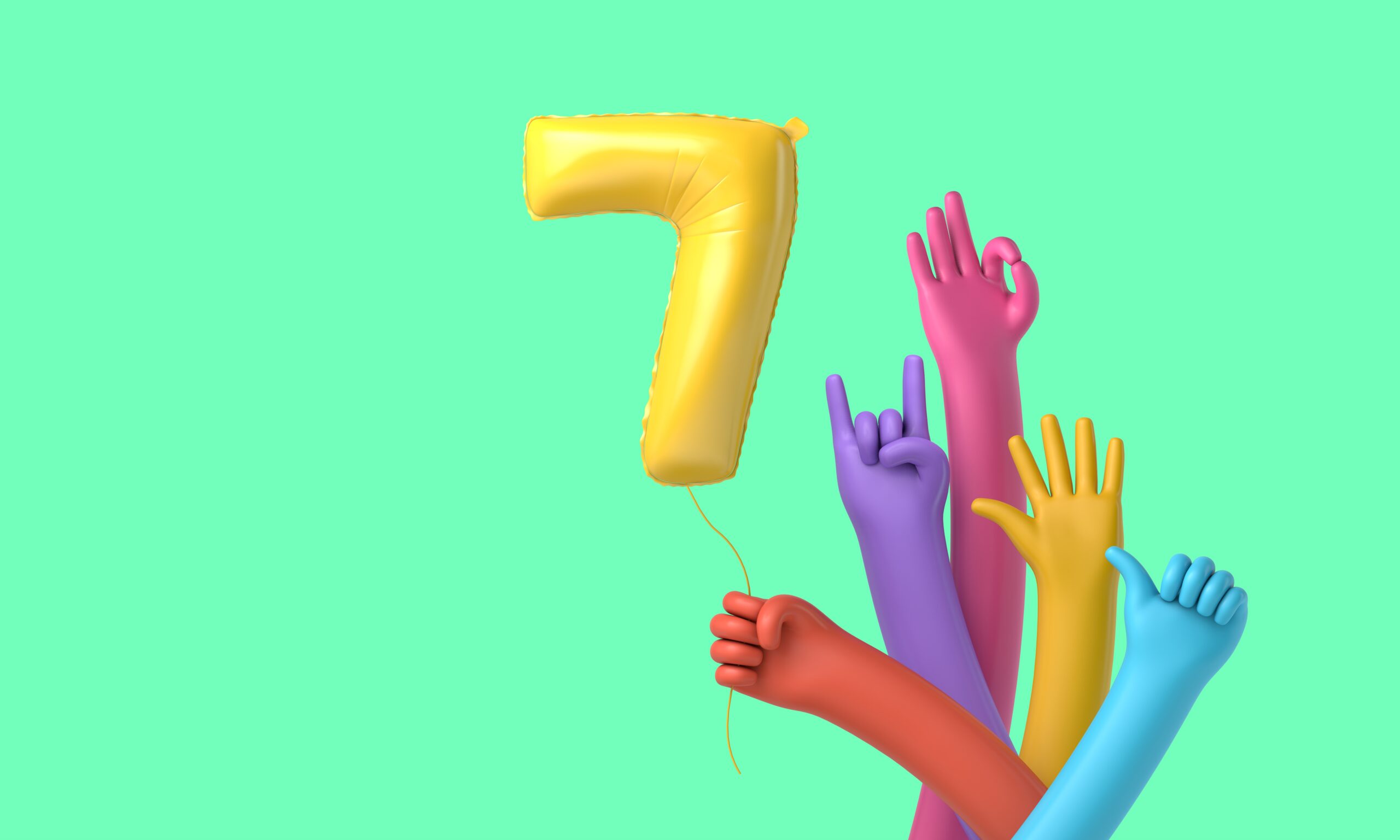
Here, rather than focusing on the digit seven, we’ll talk about the number seven.
When we look at ancient times, we see that the number seven appears in different cultures and different beliefs.
Just glancing at movie titles, you’d be surprised how many refer to seven.
For instance, Seven, The Seven Samurai, Seven Deadly Sins…
This shows that the number draws people in; it captures them.
If we look at the periodic table of chemical elements, we see that they form groups of seven.
Why was the number seven used in classifying natural elements?
During childhood, human growth hormone is secreted seven times a day.
It’s as if this number works in harmony with nature, applying itself to it.
Let’s give another example: the number of petals in flowers:
3, 5, 8, 13, 21, 34… up to 55.
You might say these are Fibonacci numbers.
In the sequence, each number is the sum of the two preceding numbers. For example: 3+5=8, 5+8=13, etc.
From the 4th number onward in the Fibonacci sequence, if you divide each number by the one that follows it, you get a result close to 0.618.
All these divisions that appear in this equality are found in flowers, trees, seeds, seashells, and countless other living things in nature, forming the so-called golden ratio, which represents aesthetic perfection.
The spiral seen in seashells is actually the golden ratio.
The human body is also structured on this golden ratio, which is seen everywhere in nature.
We all remember Leonardo da Vinci’s depiction of the human body with the golden ratio.
We could say it is a number that organizes our life.
We still don’t know why this is so.
Our ancestors developed a theory about this. They thought there was an invisible matrix behind the visible world. They assumed this matrix was built on numbers and geometry.
At the top: ideas (or archetypes, or “ayanı sabite” in some traditions). Then these ideas turn into numbers (i.e., encoded formulas). These numbers appear as geometric forms, and finally they manifest as shapes (3D forms).
Therefore, behind every shape lie geometric forms, numbers, and ideas.
It’s similar in our own reality, isn’t it? When an idea or thought comes to us, we put it down on paper to formulate it. For instance, an architect transforms the house in his mind into mathematical formulas on paper, thereby giving it shape and form.
I just referred to coded formulas for ideas and thoughts. A code is a key, a tool for interpreting something.
We use a whole host of codes in daily life: bank account codes, cellphone passcodes, computer passwords, home alarm codes, etc.
There are also behavioral codes, which we might call cultural codes.
For example, you can’t just shake hands in Japan (as a typical Western greeting), you can’t slaughter a cow in India, and you shouldn’t cross your legs in Thailand.
Besides behavioral codes, we can add social codes such as traffic codes, aesthetic codes, and so on.
So a code means rules, principles, predefined behaviors, and mutual understandings.
Humans use numbers to understand themselves, to understand nature, and to some extent to control it.
On a metaphysical level, these numbers lead us to unity and wholeness. At that point, we can no longer speak of numbers but must talk about digits: how digits influence and relate to one another.
If we speak of relationship or influence, then we touch on duality—opposites.
If we’re talking about digits, it’s because we need them to structure our world.
Because humans hate disorder (chaos).
Sometimes we do need chaos; we might compare it to a party or a moment of celebration when everyone is dancing and uniting under the music.
Numbers help us determine our place in some area of nature;
they help us find our direction. North, south, east, or west—whichever way we go, these are really just numbers specifying a location in a field.
They also define time for us. For instance, “It’s the Xth day of the month,” or “It’s the Xth day of the year,” means pinpointing a moment in time.
And these numbers originated in the sky.
Our ancestors looked to the sky to say where they were. The sun was the reference point: it rose in the east and set in the west. But what about nighttime? Then they used the stars in the sky.
There is a constellation of seven stars in the sky that is always in the north, serving as a guide in the darkness.
That constellation is called the Great Bear (Ursa Major).
For centuries, people saw this Great Bear constellation as the most magnificent constellation in the sky. In the Egyptian belief system, when someone died and was mummified, they would place the mummy so that it could see that constellation, and with a stick in their hands, they would touch the seven orifices on the human face, as a symbol of the seven stars.
They believed that the power in the sky would cause a person to be reborn after death.
We know that the Chinese also used the Great Bear constellation.
The Maya did, too.
According to the Maya, there was a god named Set who created man from corn.
Outside of the Abrahamic faiths, we can see this number seven in many beliefs.
Thus, we can say that the number seven seems to have a connection with the sky—linking the heavens and the earth.
We see this symbol, the constellation of the Great Bear, or the number seven, in the construction of cities or in the architecture of temples.
Even the layout of Paris is built upon these four directions.
How do numbers come to life or get involved in life?
Through rhythm.
Think of a two-beat rhythm.
Dancers might move from right to left or front to back.
If we switch to a three-beat rhythm, we get the waltz.
Waltz is circular.
Three is a circle.
The triple rhythm has always been associated with the sky and the whole.
With a four-beat rhythm, we have a square.
Four is the geometry of the earth, of matter.
Combining three and four gives us seven—the union of sky and earth.
Or the union of the circle and the square.
Think of places of worship: a square base topped by a hemisphere—i.e., a dome on a cube.
Because the number three can be shown with three points, and if you connect these points, you get a triangle—often used to represent divinity or the heavens. Meanwhile, a square represents the earth.
The holiness of the number seven arises in this way, and it’s called teles foros.
Teles means “to realize” or “to accomplish,”
Foros means “to carry.”
Thus, the meaning is that the number seven “carries things to completion.”
When we reach the number seven, we complete a phase.
That is, if we do our work in sets of seven, we can bring them to fruition.
For this reason, in all religions and all cultures, the universe is built on seven layers; seven realms, seven levels.
It is believed that for a person to fulfill themselves, they must pass through these seven levels and attain perfection.
It’s also described as awakening to one’s own divinity.
Square: ego/mind/body
Triangle: spirit/divinity/enlightenment
From this symbolism, a person’s transition from the square to the triangle represents enlightenment.
Hence, the pyramids are built on a square base with four triangles rising vertically.
After meeting the needs of the ego, mind, and body, a person must then nourish their spirit in order to move on to a more transcendent dimension: the symbolism of the square and the triangle conveys this.
We can call this the conflict of the inner and outer.
Using strength to achieve harmony in this conflict is the aim—i.e., peace.
In the East, there is the concept of a “peace warrior.”
Fighting for peace is not easy, because one must first be at peace with oneself.
Striving for peace presupposes being at peace within ourselves.
Everyone wants peace and tranquility, but within themselves, they’re in conflict.
That’s why it’s so crucial to turn inward, see who we are, and accept it.
Numerically, the code of nature is six, because there are six directions.
Symbolically, it’s shown as two overlapping triangles without a central point.
It’s known as the Star of David.
By adding a dot in the middle, we highlight completeness.
Nature itself is in balance.
The number six is its symbol.
If we go up to seven, we show that nature is evolving.
A baby is born into the world with certain physical equipment (physiologically), but also with potential to develop.
In that sense, humanity’s evolution is not yet finished.
The ancient Egyptians referred to this as “that which has not yet become” needing to be realized.
When a baby was born in ancient Egypt, they’d say: “You have come to what has not yet become.”
In other words, everything exists but also doesn’t exist.
Our world is “the realm of what still exists,”
But how much longer will it continue to exist? We don’t know.
So there’s a dialectic here between what has not yet become and what still exists.
Evolution is not linear; it happens in leaps.
When you reach a certain limit, you leap forward.
The number seven is a key that governs this evolution.