



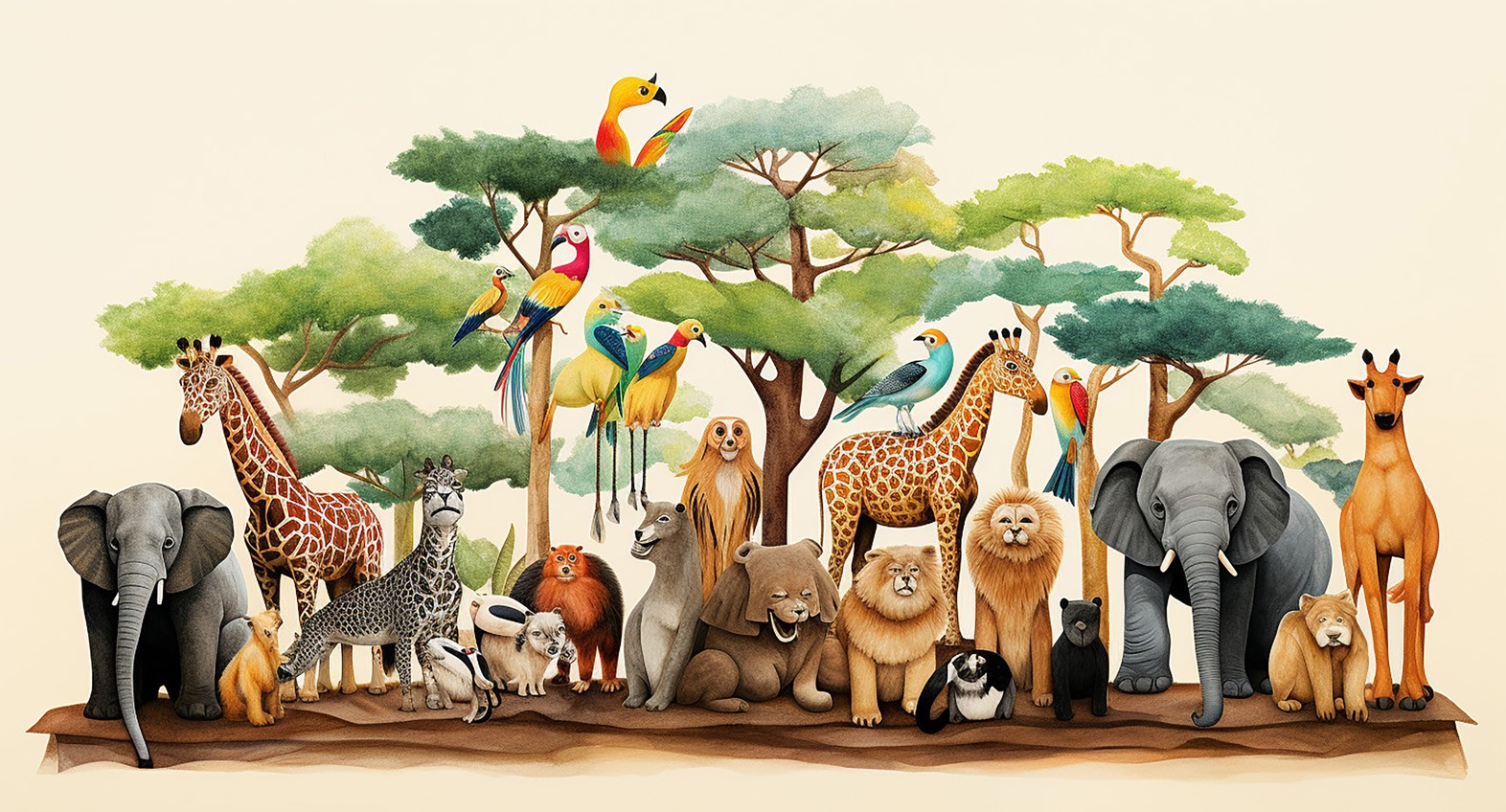
Do you think animals are afraid? Or does he shed tears? Will they be happy? If you are with an animal, If you are alive, you will definitely answer ‘yes, definitely!’ to this question. Because your cat or you must have observed your dog many times. You’re scared of fireworks when you come home, you may have noticed that you are excited and experience many emotions like this. So what does science say about animal emotions?
Unfortunately, it is not that clear about the emotions of animals and it is not possible for any scientist to understand them.
It is possible that you will be disappointed when you ask the question in the title. What about science animals?
What does science say about animal’s feelings?
Charles Darwin, who introduced the theory of evolution to the world, has a book that is not very famous for some reason:
The Expression of the Emotions in Man and Animals. In this book, Darwin talks about animals having feelings. He says that emotions such as fear, happiness, and anger were inherited from our ancestors in the evolutionary process. However, in the years when the book was published, the ideas of philosopher Descartes were dominant in Europe. According to Descartes, animals do not have intelligence and reason, therefore, animals are robots.
Descartes’ thoughts are dominant. According to Descartes, animals do not have reason or intelligence, therefore animals are robots.
The Clever Hans Incident, which took place in the early 1900s, had a mostly negative impact on animal research. However, it also set a good example for scientists who knew how to learn from what happened.
Donald Griffin, the respected scientist who discovered echolocation in bats, directed scientists to conduct research on animal consciousness in his book ‘The Question of Animal Awareness’ published in 1976. Following the interest in animal consciousness that returned with the book, a name was given to this field of research: Cognitive Ethology Scientists who want to do research on animal emotions work on consciousness in the field of cognitive ethology.
Because consciousness forms the basis of emotions. Primatologist Frans De Waal says in his book about the concept of consciousness, which we come across different definitions in various disciplines; “What else is consciousness but the processing of information?”.
Our brain converts the signals we receive through our sensory organs into information about our environment.
As a result of this information, an emotion and sometimes a movement occurs.
Scientists who want to research the emotions of animals are interested in the field of cognitive ethology.
Many studies in the field of cognitive ethology have shed light on the consciousness of animals.
From honeybees that can distinguish between Picasso and Monet paintings, to squids that pass the Marshmallow test designed for children that measures the delay of gratification, from octopus that use tools to dolphins that address each other by their names, from chimpanzees that make up after a fight to capuchins that rebel when equality is broken, evidence of conscious experience has been reached in many different ways and methods in many different species.
Thinking that only humans have consciousness contradicts evolutionary continuity.
Because consciousness is not a feature that suddenly appears in human beings, it is a skill that changes and develops as we need it throughout the evolutionary process.
Last April, NY University published the Declaration of Animal Consciousness.
The declaration states that it has been proven with scientific data that all vertebrates and a large portion of invertebrates have conscious experiences. And it adds; if we forget the consciousness of the creature in front of us when deciding on our behavior and attitude towards animals, this would be irresponsible.
As a result, studies show that animals have emotions.
They are afraid, happy, and even more, they make decisions, have behavioral flexibility, act strategically, make choices, learn, are aware of the past and future, establish cause and effect relationships, delay gratification, make inferences, and have self-awareness. Cognitive ability is at different levels in each species and individual because consciousness is a skill that develops when needed.
I would like to take the article one step further and end with a question I have posed about human consciousness; does human consciousness have the behavioral flexibility to stop ignoring the fact that other animals feel pain and pleasure, to draw its behavior to an ethical line, to question the speciesist perspective and approach all species on the same level, and to change its choices and the systems it creates in a way that does not allow any animal to be exploited and used?