



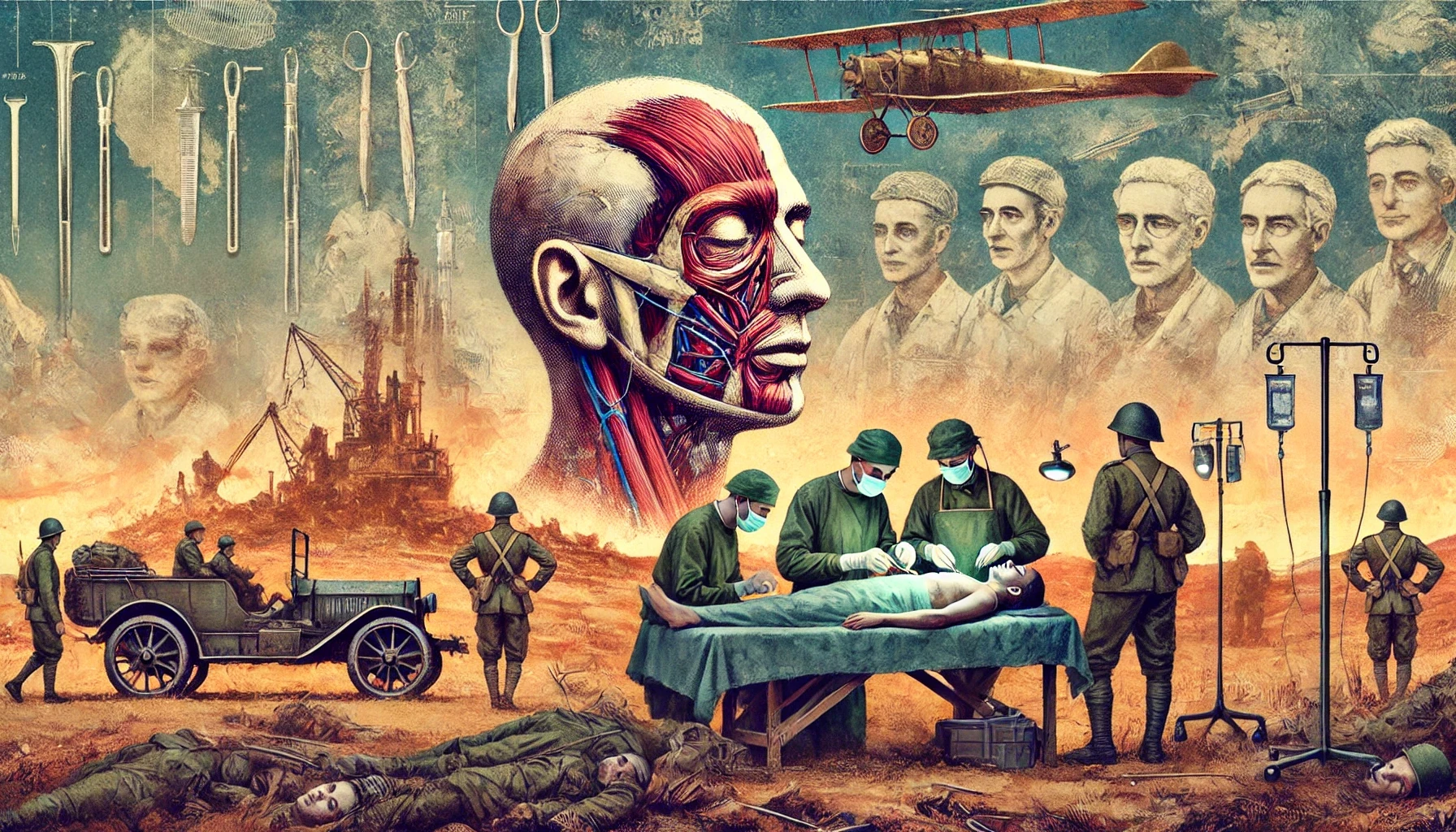
How did plastic surgery evolve while becoming so specialized
in aesthetics and beauty? What path did it follow? Through what difficult
processes did plastic surgery merge with aesthetics, ultimately giving rise to
today’s stunning faces, spectacular breasts, and sculpted legs?
In this article, I’d like to share with you both this
fascinating and at times instructional historical development and introduce you
to a highly skilled surgeon whom I consider a role model.
It’s well known that the world wars took place in an era
when modern medicine was far from advanced, yet brought with them the discovery
and use of explosives, shrapnel bombs, machine guns, and countless other deadly
weapons, marking a long history of pain, disability, and injury. The
deformities in the face and body made it necessary to develop plastic and
reconstructive surgery. By the time it reached our present day, plastic surgery
had endured many challenging stages.
During the First World War, the use of heavy artillery,
machine guns, and poisonous gas caused injuries of a severity and scale never
before seen. Trench warfare—where soldiers peeked over parapets—resulted in a
sharp increase in facial injuries.
As shells loaded with shrapnel were designed to cause
maximum harm, they were responsible for most of these facial and head wounds.
Hot, flying metal could tear flesh to create gaping, jagged injuries or even
rip off faces entirely.
Facial injuries could not be easily treated on the front
lines. Sometimes surgeons would simply sew a jagged wound together without
accounting for the amount of missing tissue. As the wounds healed, the skin
would pull and lead to a terrifying distortion of the face.
Jaw injuries rendered many men unable to eat or drink. Some
had to remain sitting up so they wouldn’t choke when lying down. Others were
blinded, or ended up with a large hole in place of their nose.
It was during this time that Harold Gillies, a New
Zealand–born surgeon trained in England, arrived in France in 1915. He
witnessed the horrific rise in facial injuries caused by this new style of
warfare. Upon returning to England, Gillies established a special ward for
facial injuries at the Cambridge Military Hospital in Aldershot. He even sent
his own patient tags to field hospitals in France, ensuring that men with such
injuries would be sent directly to him.
By 1916, Gillies had convinced his medical superiors that a
hospital dedicated to facial injuries was necessary to meet the growing demand.
The mission of The Queen’s Hospital was to reconstruct the
faces of wounded soldiers as completely as possible, in the hope they could
live a normal life afterward. Many patients dreaded what their loved ones might
say upon seeing how severely they’d been disfigured.
Gillies realized that healthy tissue needed to be
repositioned to its normal site. After that, any gaps could be filled with
tissue taken from elsewhere on the body. Surgeons already had some experience
with skin grafting. Once the work on a man’s facial bone structure was
completed, they could move on to reconstructing the soft tissues.
One of the most effective skin graft techniques involved
freeing and lifting a large flap of skin—called a pedicle—from near the
wound. While still connected to the donor area, the free end of the flap would
be turned toward the injured area, without completely severing its connection
to the body. Maintaining this physical link continued to supply blood to the
skin, increasing the chances that the graft would be accepted by the body.
Thousands of men were left with lasting disabilities after
World War I. Advances in plastic surgery and facial reconstruction offered some
relief, but many were left to fend for themselves, receiving minimal financial
or social support from the government.
Gillies recognized that these severely disfigured men would
face disadvantages in the job market. He initiated training programs to help
patients develop interests and learn new skills.
Patients reacted differently to their injuries. Many
returned home, satisfied and grateful for what had been achieved. However, some
felt reluctant to go back into a curious—and sometimes hostile—world, never
leaving The Queen’s Hospital.
Today, Gillies is often called the “father of plastic
surgery.” Many of the techniques he pioneered during World War I are still used
in modern reconstructive procedures.
The concept of cosmetic surgery also arose from
Gillies’s work. Beyond restoring function, his desire to reestablish a normal
appearance was revolutionary. For the first time, patients could have a say in
how their reconstructed nose or jaw would be shaped.
Although the results were still far removed from the purely
cosmetic facelifts and nose jobs we see today, aesthetic surgery
ultimately emerged out of necessity from the operations performed on Gillies’s
patients.
Aesthetic plastic surgeons are neither magicians nor
Creators… They are scientists responsible for carrying forward the knowledge,
experience, and innovations shaped by the painful and difficult processes of
history, guided by the light of science. That is also the principle under which
I studied and continue to practice.
I pay my respects to Dr. Gillies for his dedicated work,
wishing his soul to be filled with light.
Wishing you health and beauty always.