



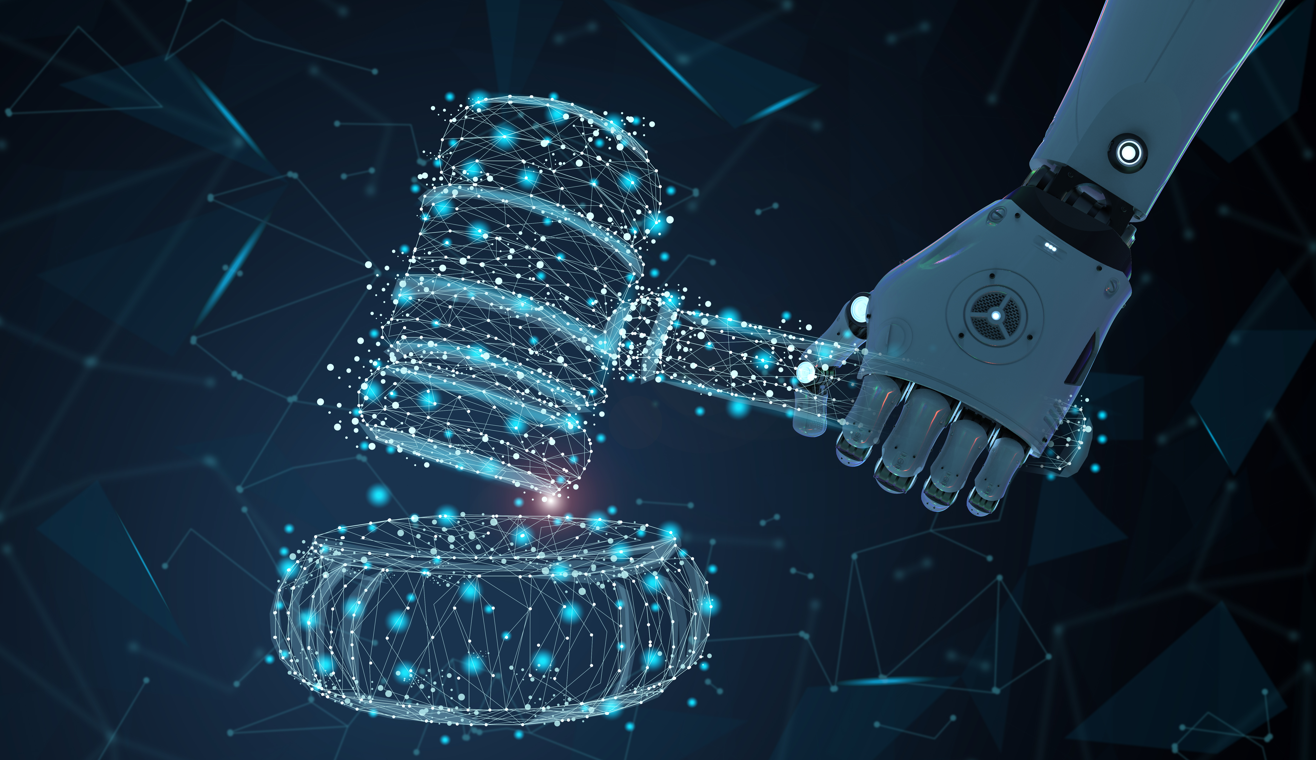
The fact that Artificial Intelligence has started to be used in every aspect of our daily lives has made the question of how it will be regulated in the field of law increasingly important, and the lack of legal regulation is becoming more evident day by day. The main point of departure stems from the fact that artificial intelligence does not yet possess legal personality. Moreover, the fact that artificial intelligence also has the ability to learn on its own, and that this may eventually enable it to develop a form of consciousness, thereby allowing it to go beyond performing merely programmed activities and gain the ability to make independent decisions, causes legal questions and problems. This also grants it the right to make choices and decide its own future, just like a being with willpower.
This is the foundation of people’s fear of artificial intelligence:
Artificial Intelligence will become increasingly powerful due to its rapid processing capability, will see humans as rivals and threats, will arm itself against humanity, and will aim to destroy and/or enslave the human race. Unfortunately, it will strive to reach this goal in an aggressive manner. The film The Matrix, for example, represents this scenario. On the other hand, it cannot be denied that artificial intelligence can be beneficial to humanity. For instance, AI was used in an attempt to alter the trajectory of an asteroid expected to collide with Earth by crashing a spacecraft into it, and as a result, it succeeded in deflecting its path.
If the subject is approached legally, it is currently not possible for artificial intelligence to be the true subject of a legal regulation unless it possesses any legal personality.
From the perspective of the legal profession; it greatly facilitates and accelerates the work of lawyers in tasks such as drafting and comparing contracts. However, artificial intelligence has not been successful in areas such as writing petitions based on legal grounds, conducting legal research, and determining direction. Representing a client in a hearing still does not seem possible. The reason is that the communications a lawyer must have with their clients, the opposing party and their attorney, the judge, and the witnesses are mostly situations that develop suddenly. They are not pre-planned or foreseen interactions. These are situations that are not subject to specific rules or molds and require emotional intelligence and spontaneous reactions. On the other hand, clients need to communicate with and trust their lawyer. Thus, it is undeniable that what makes a lawyer indispensable is mutual personal communication and emotional intelligence, and as of today, these qualities cannot be met by artificial intelligence. Nonetheless, although AI software cannot replace lawyers, it is quite significant as an auxiliary element.
The question that jurists must focus on is this:
Does a jurist have the duty to ensure a sense of justice, and in what way will this be realized? If the duty of ensuring justice is merely applying the current law to the case, is the jurist simply assembling parts like a machine?
No matter what the subject of the file the jurist is working on, its subject is a human being. Is the sense of justice merely the correct application of laws?
Even if legislation can somehow be uploaded into artificial intelligence; it is clear that it will still take a very long time to reach the stage where concepts such as honor, will, fault, and tradition can be added.