



If you ask me what it means to experience life, my answer would be walking.
In my opinion, the most powerful, most personal and most experiential way to get to know a geography is to walk.
The ancients said that there is a path to seek the truth. Ibn Arabi, one of the great Islamic Sufis, said, “The path is a path because you walk on it” and considered starting to walk as the most fundamental beginning of the path and walking, whether physical or spiritual.
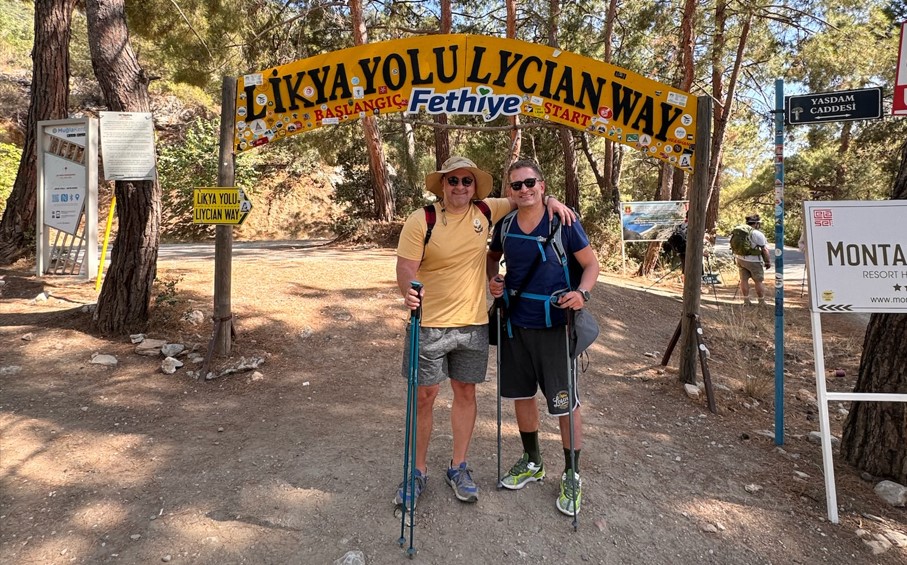
My brother and I have had a dream for many years, to walk the Lycian Way! We had never been able to do this walk because of the difficulty of organizing our work life and shared free time.
I called him on a weekend morning in April and said, “Selçuk, this will not work out like this, let’s walk this path this June” and thankfully for the firm will I showed, Selçuk did not turn me down and organized his work and came all the way from Germany to accompany me on this walk.
I wanted to share this Lycian Way, which I love very much and vow to walk in its entirety, with you, Vox Aesthetic readers.
Here you go…
First, let’s take a look at the historical processes of this road and the civilization that established this road, and then let’s continue with the road and how it made me feel.
The Lycian Way is a walking route of approximately 520 km in length, starting from Fethiye in the southwest of Turkey and extending to Antalya. The Lycian Way, which takes an average of 29 days to walk, was created by marking and mapping some of the paths on the Teke Peninsula, where ancient Lycia was founded.
The road, which was used by the Lycians for trade, military, human and animal transportation purposes, remains mostly scattered and unclear today and has continued as a path system used only by the local people as a route where shepherds walked their animals. The first and most important step in this regard was made by British/Turkish amateur historian Kate Clow, who has been living in Turkey since 1989, and the road was mapped and laid out neatly.
Kate Clow still lives in a village in Fethiye, thank you for giving us this beautiful route. When the route was defined, it was opened in 1999 as 509 kilometers.
The marking of the road was carried out for the first time by a group of volunteers sponsored by Garanti Bank and organized by Clow. You still come across the road signs of this bank on the route, but they are a bit outdated. And volunteers now contribute to making the current route clear for walkers by marking some geographical tools (stones, trees, etc.) with red and white paint instead of using signs.
The Lycian Way starts from Hisarönü near Ovacık, Fethiye, and goes to Geyikbayırı, Konyaaltı, approximately 20 km away from Antalya. The road is marked with red and white road lines with the support of this volunteer movement.
The road took its name from the Lycian civilization.
So, if you ask who were the Lycians who built this road, Lycia means the land of light, especially as someone who walked this road there, I can say that the sun really illuminates this geography more. It is truly a land of light, a geography of light.
Lycia was a region in the Western Taurus Mountains on the Teke Peninsula of the Mediterranean coast in southwestern Anatolia, where the provinces of Muğla and Antalya are today. According to historians, the Lycian people lived in the prehistoric Late Bronze Age. The Lycian people were not a civilization with a single central settlement on the Mediterranean coast. This road, which is like a mountain road connecting the dozens of city-states they established in the geography and these centers, was built to serve commercial and military purposes, depending on the conditions of the period. The most important known Lycian centers are city states such as Xanthos, Patara, Myra, Pınara, Tlos, Olympos and Phaselis, which united at that time and established the Lycian Union.
A brief look at the history of Lycia;
B.C. 15-14. It is a nation that existed in the Teke Peninsula of Anatolia from the 19th century until 546 BC. Lycia was also a federation of ancient cities in this region and later a province of the Roman Empire. Its name is mentioned as “Lukka” in Hittite records.
It is thought that the Lycians originally came from the Luwians. This race later established a close relationship with the Hittites and shared common values. It is said that the communities that make up the Lycians are a continuation of some of them after the dissolution of the Luwians, who came to Anatolia in the second half of the 3rd millennium BC and lived in the Southern Anatolia region for 2 thousand years and were the oldest people of Anatolia of Indo-European origin. It is thought that the Luwian language is close to Hittite and the Luwians are related to the Hittites, and therefore the connection between Luwian and Hittite is understandable.
An inscription called Stadiasmus Patarensis, found near Patara Harbor and translated by Prof. Dr. Sencer Şahin in 1994, states that Lycia was a Roman province in 43 AD and lists 69 roads and 53 cities in the region.
Although fewer of these cities have survived to the present day, the geography contains many ruins.
Thanks to their strategic location, Lycian cities had the best opportunities for maritime trade and even piracy, and this strategic importance did not escape the attention of other empires.
In later times, the Lycian region was occupied by the Persian Empire and the Ancient Greeks, and later ruled by the Ancient Romans, the Byzantine Empire, the Seljuk Empire, and finally the Ottoman Empire.
Rock tombs on the slope walls and sarcophagi in the region are evidence of the Lycian civilization.
Let’s get to the routes; This place is important for those who want to walk because the road consists of many different routes. These routes are all beautiful, whether you walk them individually or with tour guides. However, one point that should not be forgotten is that the routes have become blurred in some places and some roads are now replaced by other connections and modern roads. So, if you are going to set out individually, you must have a compass, a map or a modern GPS, otherwise you may get lost.
Of course, this problem does not exist for those walking with guides, but you should still have equipment, just in case.
The general routes of the Lycian Way include the following stages.
Hisarönü (Ovacık)-Faralya, Faralya-Kabak Bay, Kabak Bay-Alınca, Altıburunlar-Gavurağılı, Gavurağılı- Patara, Patara-Kalkan, Kalkan-Sarıbelen-Gökçeören, Gökçeören-Kaş, Kaş-Kekova, Kekova-Demre , Demre-Alakilise-Finike, Karaöz-Gelidonya Cape-Adrasan, Adrasan-Olimpos-Çıralı, Çıralı-Beycik, Çıralı-Tekirova, Tekirova-Phaselis-Gedelme, Beycik- Tahtalı Mountain-Gedelme, Gedelme-Göynük, Göynük-Hisarçan.
Walking routes generally vary between 4-6 days, you can walk in a season and route that suits you. The most suitable seasons are spring and autumn, but I did this walk in summer and on the route I went, the heat at the top of the mountains did not bother me much, but I did not forget to drink plenty of water. There are many tour companies in the region that provide these services, and on average, all of them will satisfy you.
When choosing this walking route, we planned what the view should be during the walk. If you want your view to pass through the mountains, paths, villages and always have the sea on one side, I recommend the Ovacık-Faralya-Kabak-Alınca-Yediburunlar-Gavurağlı-Patara stage.
The feelings we felt while walking this route with Selçuk were amazing. With a path from the tops of the mountains, your sea view changes with a new perspective every moment, and suddenly you may find yourself in an olive garden under an olive tree, or you may discover yourself as a guest in a nomad village where aunties offer you cold ayran. While your path sometimes takes you down to the valley bottoms and traces the edges of the caves, the oleander buds bursting from the stones tell you with a wind that you feel that this is still an ancient place.
It is important to arrange light but professional equipment before you start walking. You drink plenty of water, so your bottle should keep the water cold. We drank 5-6 liters of water a day while walking, and be sure that hot water does not relieve your heat enough.
I continued with a simple backpack, light trekking shoes and a hat. I only had a water bottle in my bag. I can assure you that unnecessary weights tire you out on the road, the lighter you are, the more comfortable you will be. We already went with a guide, and during our stay, apart from walking, our luggage was being transferred from our previous boutique hotel to our next boutique hotel. My advice to you in this regard is to take this journey with a tour so that other chores other than walking do not distract you from the joy of the journey.
As I end my article here, I feel that walking is not only a physical benefit but also an important part of our spiritual balance.
I hope we will have a life full of walking and the stories we understand by walking.