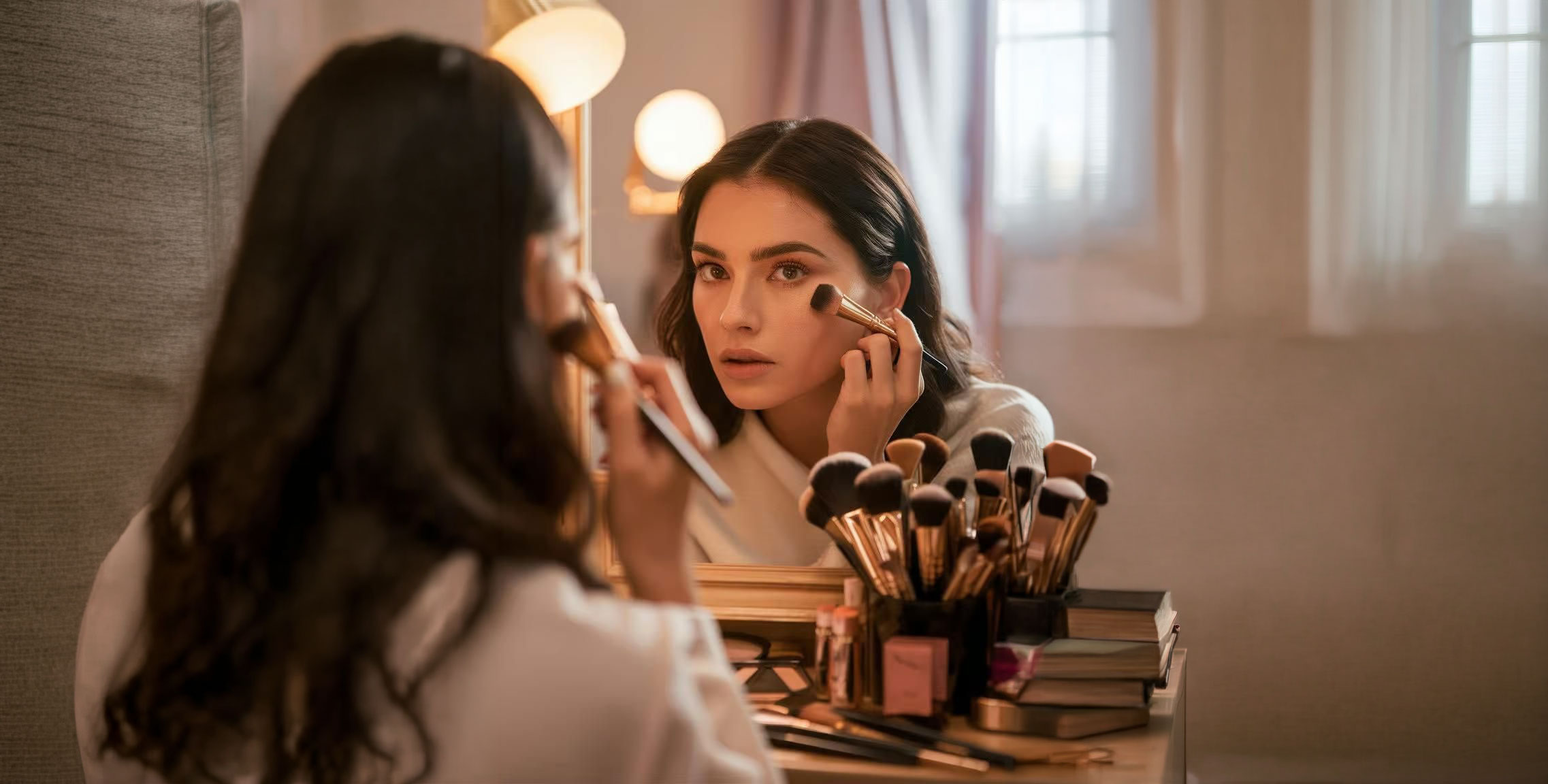
One morning, you look in the mirror. Your face is there. You are there too. But something in between feels missing. Or rather, someone whispers: You could be better.
A filter. A cream. A procedure. A “tiny touch.”
It’s not enough.
Because beauty is no longer a state of being, but a target. Even a never-ending to-do list.
Why Isn’t Being Beautiful Enough Anymore?
Once, being beautiful was an adjective. Now it’s a project—something that must be constantly updated, carefully maintained, never allowed to fall behind.
Years ago Susan Sontag observed: “To be a woman is to be condemned to visibility.” Today, that visibility is almost 24/7.
The camera is on.
The mirror is ready.
Comparison is already automatic.
Being beautiful isn’t enough because now you’re expected to be more beautiful. And that “more” is never fully defined.
One day it’s your brows, the next it’s your lips. Today: natural but full. Tomorrow: minimal but pronounced.
“Be natural,” they say.
And then they tell you exactly how to be natural.
Even “Natural” Is for Sale Now!
The most ironic part? Even naturalness is being marketed.
“You can’t even tell.”
“So fresh.”
“It’s you—but better.”
If Roland Barthes were here, he’d probably call it a mythology. Because naturalness is no longer a state of nature; it’s an aesthetic construction.
And we women aren’t just the lead actresses in this construction—we’re also its audience.
We look at ourselves, and we critique ourselves.
In The Beauty Myth, Naomi Wolf puts it plainly:
“As women gain power, beauty standards harden.”
Not a coincidence.
The freer we become, the more we’re tried to be controlled. And that control is often built on our bodies.
Because a woman busy with her body has less time to think.
And while we’ve been getting lost in the mirror for years, time has been passing quietly.
And there’s this:
What matters now isn’t the beauty we have, but the beauty we’re supposed to become.
A version we haven’t reached yet—but we’ve been convinced we must.
That’s why it isn’t enough.
Because the target keeps moving.
If Virginia Woolf were alive today, perhaps she’d add: “If a woman doesn’t have a room of her own, she can’t have peace on her own face either.”
Everything is a little too loud.
Maybe the point is to add less.
Not to fix things.
Not to hide things.
To pause.
To look in the mirror and say:
“I am enough—right now.”
It’s a small sentence, but radical.
Because the system doesn’t like that sentence.
Simone de Beauvoir says:
“One is not born, but rather becomes, a woman.”
Perhaps today we need to add:
A woman is made—but each day, again and again, by choosing herself.
A reminder;
Beauty isn’t a competition.
It’s certainly not an investment.
A state.
A gesture.
A mood.
And most importantly:
No one has the right to demand a “better” version of you.
You don’t have to be beautiful.
You don’t have to be natural, either.
But you do have to be yourself.
And maybe that’s the greatest luxury now.
Unfiltered.
Unedited.
Real.
And right here, a small but important parenthesis needs opening.
The aesthetic world isn’t the enemy in itself.
Plastic surgery, dermatology, rituals of care…
All of it is born from a need, a desire—sometimes from a state of healing.
The relationship we build with our bodies sometimes wants to repair.
Sometimes to complete.
Sometimes simply to feel better.
That’s not the problem.
The problem begins where this world insists there is only one right way.
The problem begins the moment the choice is taken from us.
Because aesthetics liberates only when it is chosen.
Only when it is born not from “I should,” but from “I want,” is it real.
What’s authentic can be not touching anything at all,
or wanting a touch for yourself.
Applause is not for the most natural
nor for the smoothest.
Applause is for the one who knows herself and decides.
For the one who can look in the mirror and say:
“This is my body. This is my face. And this choice belongs to me.”
Because the truest beauty
is knowing where you stand.
And yes—sometimes beauty asks for an intervention.
But it always asks for freedom.
MELİS ÖZCAN